01 · The distillation
The camera counts photographs.
The journal counts visits.
A lingering raccoon can fill a memory card without telling you anything new — the season's record is 707 photographs of a single visit, Notch on the first night, June 7 at 10:15 pm. So consecutive sightings collapse into visits, and twenty nights of shutter become a number a person can actually read.
02 · The night shiftn = 118 raccoon visits
The yard clocks in at dusk.
Of the 118 raccoon visits with an arrival time, 98% arrive between 7 pm and 7 am. The rush peaks in the nine-o'clock hour; a typical stay runs five minutes. The busy window wraps around midnight — so the chart does too.
Bar length is the count of visits that began in that hour; the shaded arc marks 7 pm – 7 am. The two daylight arrivals are ringed — the kind of visit the dashboard flags as off-pattern. data/twoaxis.json
See the numbers
03 · The cast5,136 named photographs
Five names.
One very unequal guest list.
Human confirmations put a name on 5,136 photographs — and Stan and Notch account for nine in every ten of them. Pepsi appears forty-nine times less often than Stan. Fame in this yard is a long tail.
Portraits are real crops from the export; Miss B. and Pepsi were photographed too rarely to make its public slice. data/meta.json
04 · Appearance5,356 pairwise comparisons
The camera remembers the night better than the animal.
Compare every pair of the 104 raccoon photographs in this export, in the re-ID model's own similarity space. Frames from the same visit look alike — 0.51 on average, with bursts touching 0.99. The same raccoon on a different night? 0.23 — barely ahead of two different raccoons at 0.15. Pose and backdrop outweigh identity, and a single photograph cannot be matched across nights.
Each row is the distribution of one kind of pair; darker means more pairs land there. Ticks mark the mean. data/appearance.json
See the numbers
The rescue is averaging: collapse each visit's best frames into one prototype and identity starts to win — same-raccoon prototype pairs average 0.51 against 0.37 for different raccoons, and the best cross-night match hits 0.84.
Separated, but overlapping — which is why the system suggests and a human confirms. data/appearance.json
See the numbers
05 · The gate320 scored crops
A species model can't say “nothing.”
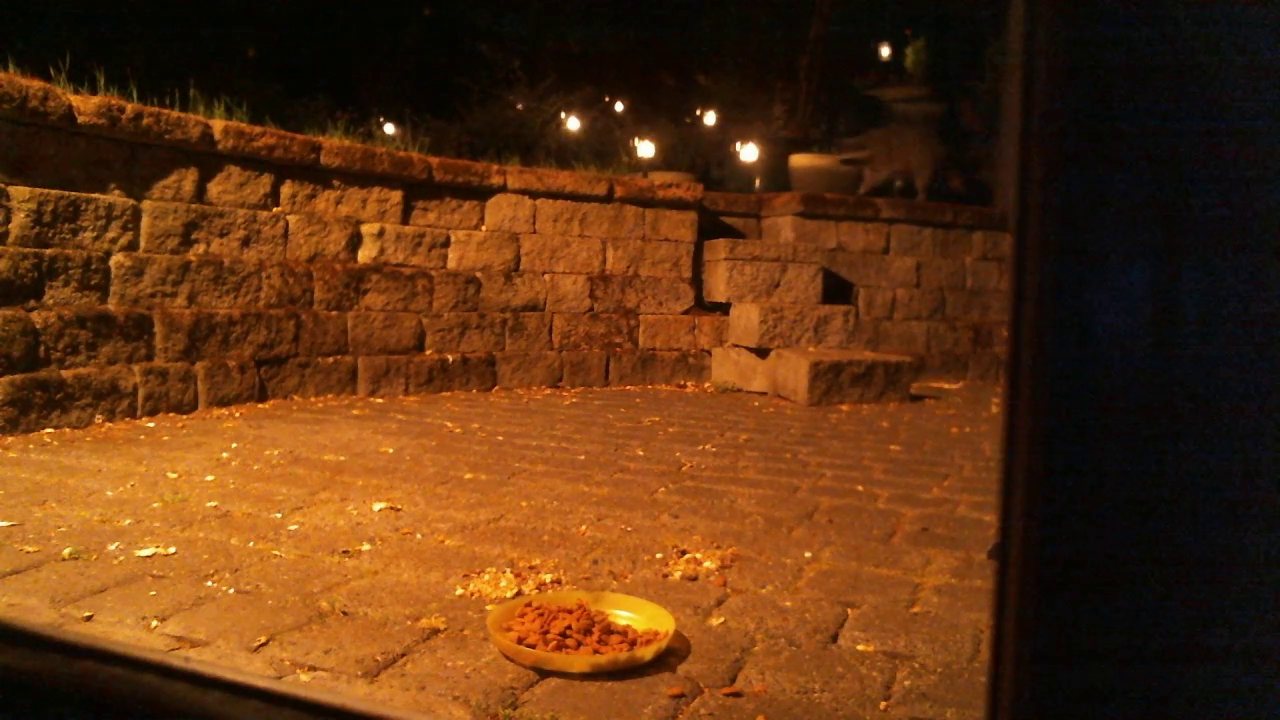
BioCLIP names species — show it an empty deck or a plate of kibble and it must still pick one. (For a while, every false alarm was a “brown rat.”) So a general CLIP goes first and answers the only question that matters: is this an animal at all? On 320 scored crops the two populations never touch: every real animal scores below 0.43, every non-animal above 0.60. The threshold sits in open water — zero crossings, in either direction.
One dot per crop. The hairline at 0.60 is the live rig's actual cut. data/decoy.json
See the numbers
06 · Gait7 measured walks
Every walk keeps time.
From each behaviour clip, the tracker reads the body-bob of a walking raccoon and recovers a stride — from a 0.8 Hz amble to a 3.3 Hz trot. Path straightness spans just as wide: 0.13 (milling about the plate) to 0.88 (a beeline across the wall). A limp would read the same from any camera angle — which is what makes motion the second axis of identity.
Each dot is one tracked walk; the pulse repeats at that walk's measured cadence. data/gait.json
See the numbers
07 · Confidence, auditedgraded against human verdicts
Believe the label by day.
Squint at it by night.
Grade the model's confident species labels (≥ 0.8) against every human verdict, and daylight keeps its promise — night doesn't. Through the glass, infrared is monochrome and soft, and a confident label in the dark is far likelier to be wrong than a confident label at noon. The camera didn't reveal that; the audit did.
The season is still being written.
Every number on this page is computed live from the same frozen export that powers the making-of demos — regenerate the export and this page follows. Behind the glass, the journal keeps going.
Provenance
- Toplines & cast — data/meta.json
- Arrival clock, stays — data/twoaxis.json (118 raccoon visits)
- Similarity distributions — data/appearance.json (104 crops · 5,356 pairs · 16 prototypes)
- Gate populations — data/decoy.json (320 crops scored with the live gate model)
- Stride cadences — data/gait.json (7 tracklets from behaviour clips)
- Record visit & un-blend — data/reid_game.json
- Day/night accuracy (Jul 1) and re-ID ROC-AUC (Jul 18) — dated eval.py runs; reports/ is deliberately gitignored, so reproduce them on your own corpus rather than quoting these.